

- What if we approached our poop with gratitude instead of disgust? New language can help us break taboos around our own excreta, recognize the people who handle it after it leaves us and envision a better future for sanitation.
- Faith communities have a role to play in sanitation and climate resilience. Their commitment to care for creation, children and vulnerable populations makes them powerful partners in addressing sanitation challenges and in recovering from climate disasters.
- Nahar has coined terms like defecatory justice, or poop justice, to connect how we treat human excreta to how we treat people and the environment.
- The way we flush and forget our poop reflects society's broader tendency to treat certain populations as expendable. As Nahar puts it, “Away is someone else’s here.”
Sarah Nahar is an environmental and religious scholar at the University of Michigan where she studies (among other things) the toilet: the apparatus, toilet practices, what happens after the flush and how this impacts our world. She brings her Mennonite background to this work at the intersection of sanitation, environment, justice and religion. I first saw her speak at The Rich Earth Institute’s virtual Summit and wanted to learn more! We spoke over a video call about her work and her visions for the future.
This interview has been edited for length and clarity.
Allen: What got you interested in this field? How did you get started?
Nahar: I was leading groups doing unarmed civilian accompaniment in areas of lethal conflict. It's called Community Peacemaker Teams, and we're building partnerships to transform violence and oppression — dealing with our shit metaphorically. In all of those social struggles, I saw how there was an ecological dimension. After doing that for a while, I ran away with the circus.
Allen: The circus?
It’s called the Carnival de Resistance, and it's an eco-theological carnival. We were showing people how it's possible, even in urban spaces, to rewild. We lived in tents. We had a fossil-fuel-free kitchen. We performed under a red and white big top. These kinds of exercises, very specifically in this case, invite Christians to see just how enchanted and just how non-anthropocentric the biblical text is. (We had the story of Noah's Ark, represented by not the people in it, but the raven and the dove. These two primordial birds and symbols carry messages about the changing climate.)
We'd have a residency and we'd build the carnival world, and we’d do projects and teach during the day and repair bicycles. We traveled everywhere by bike, we lived in tents, and we used composting toilets.
I did okay in the tent, but once we got to the composting toilet, I was like, nope, this is where I draw the line on this “hippie stuff.” That's not happening. That's disgusting. But when you gotta go, you gotta go.
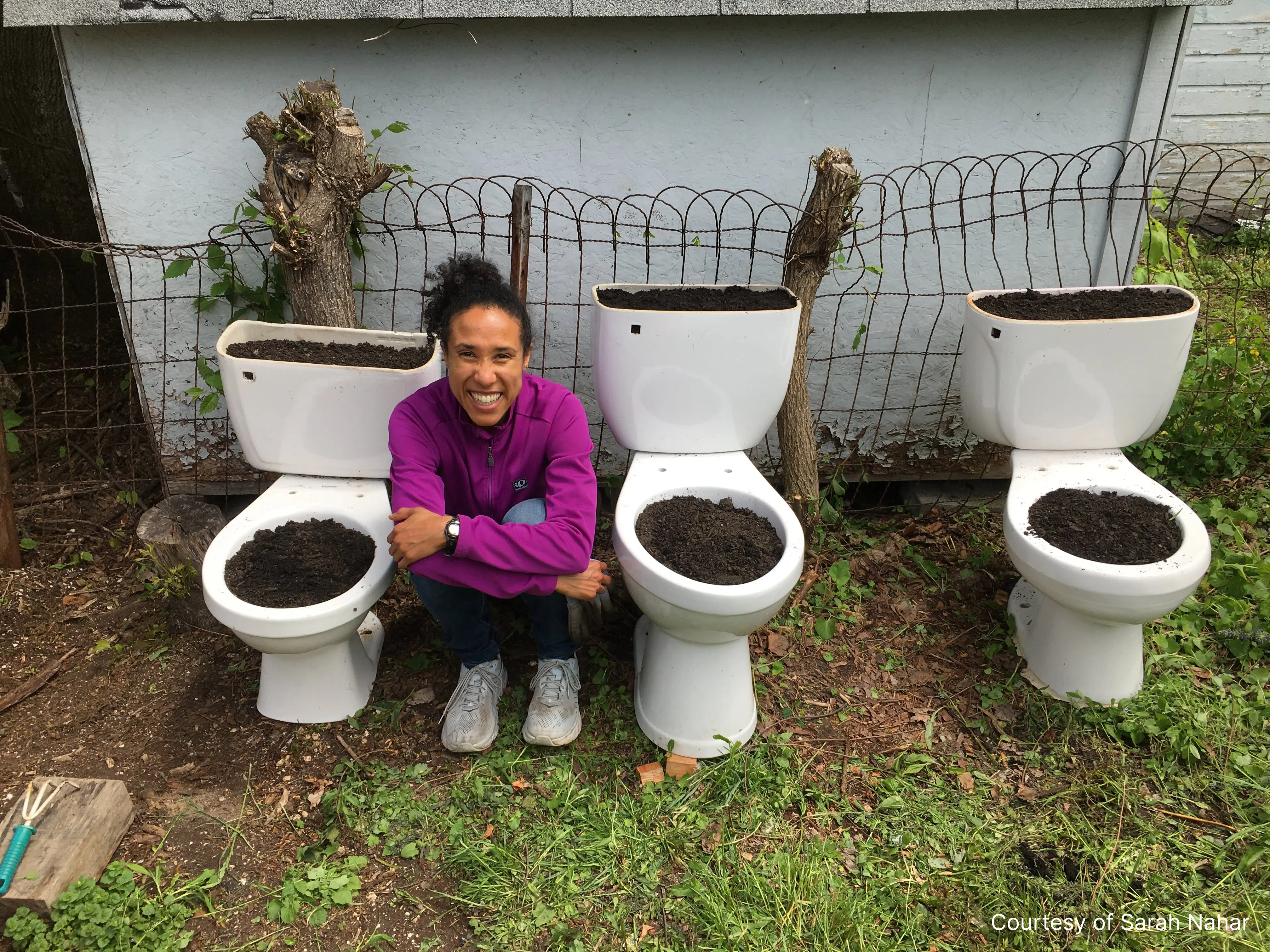
So I went, and I did not die. In fact, instead of the water flush, we put a scoop of sawdust on top. And then at the end of the carnival we got to see where the urine and feces were going, how it could make biochar with the urine, how you could fertilize an orchard or flower grove with the feces. I was wowed. Oh my goodness, I remember exclaiming, I have a new life goal! I do not want to shit in fresh water again.
But then I realized how the freshwater flush toilet — the apparatus — is part and parcel of the dominant infrastructure. And the dominant infrastructure is perpetuating business as usual, and that is a flush-and-forget mentality. It’s using water pathways to handle our excreta, which is negatively impacting rivers and lakes. Although it’s called human waste, it is not waste, it's a discarded resource. In nature there is no waste, and so I became interested in how to not waste excreta — how to use the resources within it.
Wastewater treatment plants currently incinerate, discharge, or land apply excreta. But it’s not just excreta. Due to combined sewer design, we’ve got industrial chemicals mixed in there. We have runoff from cars, and everything in stormwater. So much. It is not a simple issue to disaggregate everything; that’s humbling.
I wanted to ask more questions about this. So I googled “compost toilet academic,” and found the people who would become my doctoral advisors!
[In the end, Nahar got two PhDs, one in environmental studies and one in religion.]

Allen: I read about your class Holy Shit. Will you tell me about it?
Nahar: I’m teaching a class called "Holy Shit, Your Poop and Why It Matters to God,” which I also hope to title the book I’m writing. Of course, I can't put shit in the academic course catalog, so I put Sh!t and I also put G!d to help us think about what ideas we distance ourselves from, and what is the difference between a taboo of reverence and a taboo of repression.
In the class we examine, among other things, my hypothesis, that we won't stop treating people on the planet like shit until we stop treating shit like shit. We study how our toilet infrastructure communicates worldviews, standards, and culture in addition to functioning as a way to separate us from pathogens.
Allen: What kind of reactions do you get from the students in your Holy Shit class?
Nahar: It’s a totally full class; they came to receive something completely different in their education. Some are curious about what their various religious upbringings have to do with the body, and worldview, and environmental justice and politics. And so we look at that.
In giving good attention to dealing with our shit — literally — we can start to do it more metaphorically, and we start to be willing to be with conflict longer, or deal with the gross stuff of life, or to face difficulty and to also think about what's happening after the flush.
These questions about what's going on after the flush are absolutely critical because there is no such place as away. Away is someone else's here.
Allen: You’ve coined several terms like excreta infrastructure technology and defecatory justice. Can you explain these terms in a simple way?
Nahar: Defecatory justice, or poop justice, is both about the person pooping and the material itself. It’s a term within the concept of environmental justice, which is not just about people and not just about the environment, but holds both together, declaring that the struggle of the people and the struggle of the earth is one struggle.
And then excretory justice will just take us more broadly to cover urination and menstruation mostly.
Excreta Infrastructure Technology Systems, or ExIT systems for short, are my way of talking about the toilet, because if we say the word “toilet” an image in our mind often pops up of a porcelain white pedestal basin full of clear water attached to a piping system.
The longer we have that as our image of how we will pass on our nutrients to the next stage, the more difficult it will be to shift towards what other ExIT systems might exist. Maybe we need to use container-based ones, or ones with urine separating and diversion, or ones that invite us to squat. So that's the reason to say ExIT system instead of toilet, as much as possible. And it’s kind of cool because the material we're talking about is not waste, it’s just what is exiting us — excreta.
Allen: Do you feel like language will help us move past where we are now to where we need to get to?
Nahar: Yes, language is a really important component. Do I think language is everything? No.
We're going to build these different ExIT systems, do a lot of stuff to change how potty training is done as well. But because vision is so important, language is important too. My vision is of clean, flourishing oceans. A vision that one day sewage finds its way into the proper receptacles, where our mushroom and fungi and mycelium can digest, decay them, rot them, and turn them into topsoil. Without imagining that possibility, it's just more difficult. And current language—or taboos about speaking about poop at all, block us from articulating that vision. Shit isn’t a bad word, it comes from the word to separate (and the word science comes from the same roots too). But when we use shit to mean something negative, it reinforces how we think about our excreta. So yes, language has a big role to play.
Allen: Can you describe your vision for where we as a culture need to get to with our ExIT systems? What does it look like?
Nahar: It's not one size fits all in terms of what our different ExIT systems will look like. Figuring out what ExIT systems work best for any particular place requires collective governance, and that will happen best on the municipal level or bioregional level. This work requires deep democracy and people being willing to get serious and talk shit. They require decentralized infrastructure systems, a diversity of ideas and of people, and knowledge of local watersheds, flora, and fauna.
I think working on something so basic as to how to safely contain, transport, process, and reuse excreta is a real creative opportunity for us as humans to deal with our crap, literally and metaphorically.
.jpg)
Allen: You’ve written that issues of defecatory justice should matter to Christians. Could you talk a little bit more about this?
Nahar: Malnutrition, caused by dysentery and by lack of clean water (as a result of shit getting in the water), is killing more kids a day than measles and wars combined. And for folks who talk about caring for creation and talk about caring for kids, it ought to be a major issue. But we can't get traction on it because there's some taboos, and this mundane activity doesn’t command a lot of press. But it’s a matter of faith to break the taboo for the sake of the wellbeing, the wholeness of all people.
Right now in October 2026, there's one toilet for every 4,500 people in Gaza. Sanitation also gets used as a tool of war, since pathogens kill. Now I know a lot of Christians have supported a lot of war for a long time, but as a Mennonite, I don't think we should be doing any violence or war in Jesus' name. If creation is good, then there should be nothing off limits to talk about and to contend with.
And there’s also the parallel between how we treat excreta is also unfortunately how we flush and forget populations: disabled folks, indigenous folks, incarcerated folks, refugees. So this flushing and forgetting practice that we do when we use a toilet like that, it's like devotion. It reinforces a worldview that we're devoted to. The freshwater flush toilet does separate the pooper from their pathogens, but there are other safe ways to do that that would not harm the world. So it's an invitation to deeper love.
Conversion literally means to turn around, to return and remember who we are and whose we are. To deal with our shit metaphorically can be facilitated by dealing with it literally, and not being ashamed of our bodies and their production, but to make sure that this gift we are giving the earth remains a gift and doesn’t curse it through the pathways we currently put it on after we excrete.
Allen: You've done a lot of education around this topic in both religious communities and nonreligious ones. Do you feel like people respond differently to it based on their religious backgrounds?
Nahar: There's more surprise in the religious communities. Also, religious communities of all backgrounds are poised to be climate justice hubs because there's a collection of people and a collection of energy and infrastructure that people always go to during climate disasters.
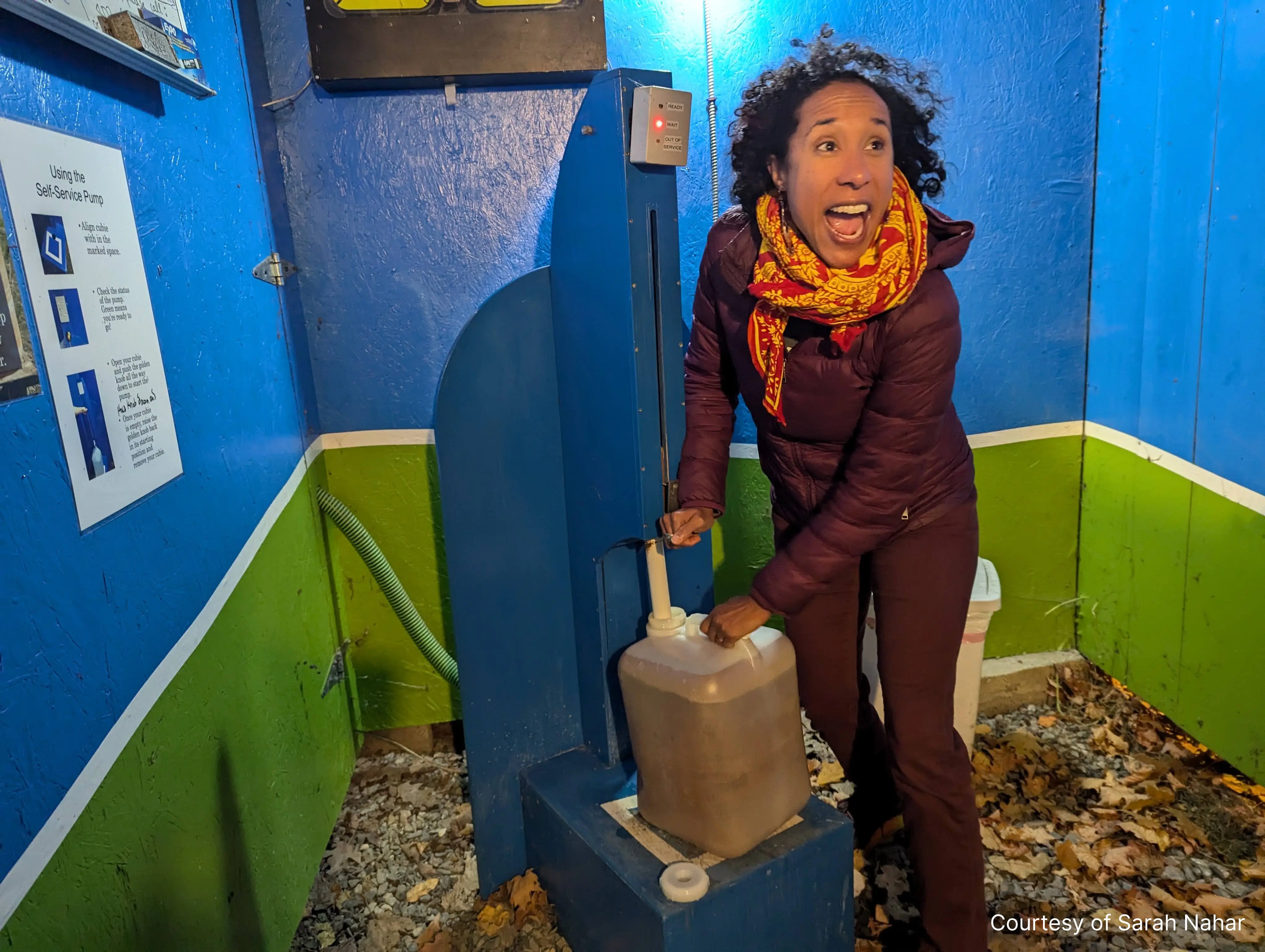
So these communities know they need to be prepared, but they don't always know how or what to prepare for. Power outages can impact toileting systems. Religious centers will be places where people go with the bucket toilets or containers, to help stop the spread of disease, and have a safe place to excrete. And so, they're kind of surprised, like, oh, I actually do have resources in my tradition for making a difference.
Allen: What else do you want people of all backgrounds to think about regarding sanitation?
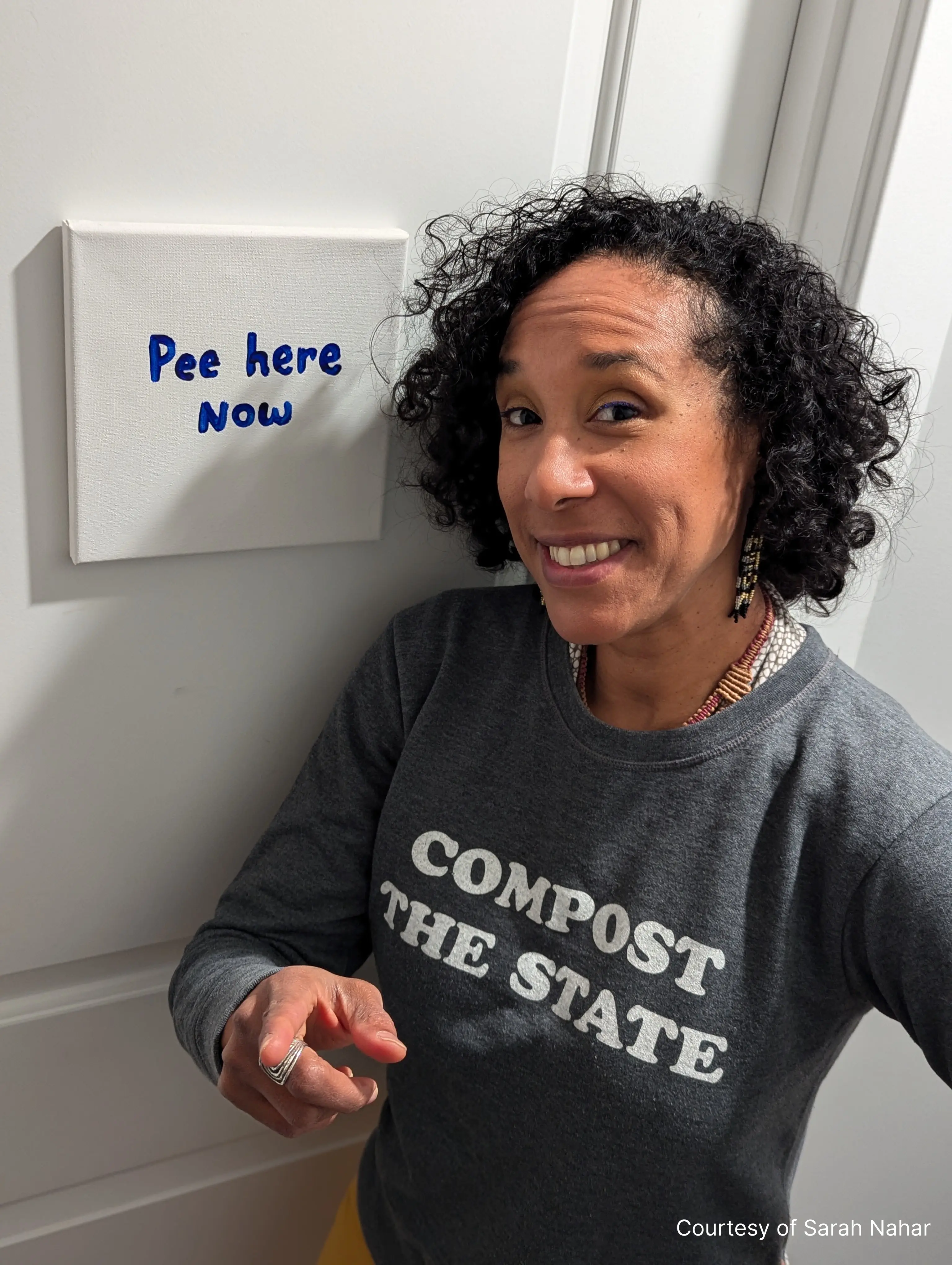
Nahar: There's a couple of invitations. One would be to invite people to say thank you after they use the restroom. Thank you to their bodies. Thank you to whoever will be doing the labor with your poop and pee afterwards. That transforms a habitual moment into an intentional one. That intentionality has a lot to do with the vision and becoming more intentional people.
The second is to not call our poop and pee waste, but to call it excreta. To call it what's exiting us, or to call it urine and call it feces, find the words for it.
Third, if you don't mind: if it’s yellow let it mellow, if it’s brown flush it down. If that works in your area.
Fourth, integrate excretory justice together with the other things you’re working on. This will be important because it's less about people installing compost and toilets just in their own home, but much more about how we organize together to change municipal codes to allow for closed-loop sanitation. [We need] to address the massive amount of septic failure and overflow that we have.
Lastly, this is an organizing project for the common good: I want people to do unto those downstream as they would have those upstream do to them.
Laura Allen is a writer and educator based in Oregon. She co-founded Greywater Action, where she teaches people how to transform their homes to reuse water. She authored the books, The Water Wise Home: How to Conserve, Capture and Reuse Water in Your Home and Landscape, and Greywater, Green Landscape. Her article, For a better brick, just add poop, won the Gold Award in Children’s Science News from the AAAS Kavli Science Journalism Awards (2023). Her favorite pastimes include gardening, hiking, reading and visiting eco-toilets.
